
Why does my steering wheel shake when braking?
A shimmy in the wheel or a pulse in the pedal that shows up only when you brake tells a different story than a shake at highway…
You back out of the driveway and there is a stain on the concrete where the car was sitting. It is one of the most common reasons people call us, and the first question is always the same: is this serious? The honest answer is that it depends entirely on two things — the color of the fluid and where under the car it is dripping from. Some leaks are a genuine "stop driving it" problem. Others are literally just water. Here is how to tell them apart before you panic or ignore it, and what each one actually means.
On a lot of days, especially in a Graham summer, the puddle under a car is not a leak at all. If you have been running the air conditioning, the AC system pulls moisture out of the cabin air and drains it onto the ground — a small pool of clear, odorless water under the middle of the car after a hot drive is completely normal. It is the single most common false alarm we get. Your AC runs more than you think, even in winter, so this can show up year-round.
The quick test: dip a finger in it or lay a piece of white cardboard under the car overnight. If it is thin, clear and has no smell, it is almost certainly condensation and you can forget about it. If it has any color, any oily feel, or any smell, keep reading.
Color tells you what the fluid is; position tells you what part is leaking. Before you wipe it up, note two things: roughly where under the car the drip sits — front, middle, or back, left or right — and what color it is on clean cardboard rather than on dark gravel or asphalt where everything looks black. Those two facts together get us most of the way to a diagnosis before the car is even on the lift.
Most of what a car can drip falls into a handful of colors. Here is how to read them.
Usually AC condensation, as above, and usually nothing. The exception is if it smells faintly sweet or is slightly slick — that can be diluted coolant rather than water, so check the color again in good light.
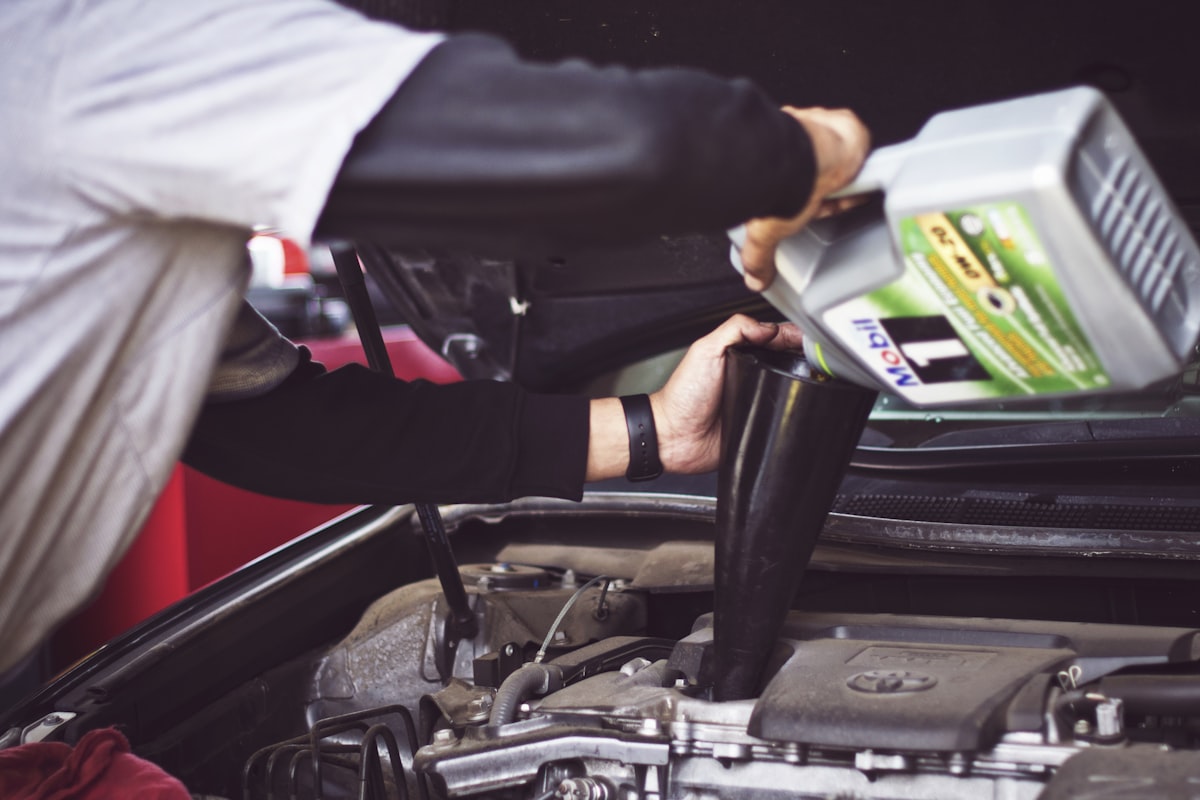
This is engine oil, the most common real leak we see. Fresh oil is amber; older oil is dark brown to black. It typically shows up under the front half of the car and feels genuinely slippery between your fingers. A few drops now and then from an older engine is common and worth keeping an eye on; a spreading puddle, oil on the driveway every morning, or a burning smell after driving means it is finding a hot part of the engine and needs looking at sooner. Low oil is what turns a cheap gasket into a wrecked engine. If you are also due for a service, an oil change is a natural time to have the leak traced.
Red fluid is almost always one of two things: automatic transmission fluid or power steering fluid. Transmission fluid tends to drip from the middle of the car and is the more expensive one to ignore — a transmission that runs low gets hot, and heat is what kills gearboxes. Power steering fluid leaks nearer the front and often comes with a whine when you turn the wheel and a heavier steering feel. Either way, red under the car is not one to leave for a month. Our engine and transmission work starts with finding exactly which of the two it is.
This is coolant, also called antifreeze, and the giveaway is the smell: distinctly sweet, almost syrupy. Modern coolants come in green, orange, yellow, and even pink depending on the type, so color alone will not tell you much here — the sweet smell is the real signal. A coolant leak matters because it leads straight to overheating, and an overheated engine is one of the fastest ways to do serious, expensive damage. One more thing that is genuinely important in a neighborhood with pets and wildlife: coolant is sweet and highly toxic, and animals will lick it up. Do not leave a green or orange puddle sitting on the driveway. A coolant leak usually ties into the cooling and heating system, and it is worth catching before a hot day on I-5.
A slick, oily fluid — clear when fresh, browning with age — that shows up near a wheel or under the driver's footwell can be brake fluid. This is the one to take most seriously of all, because brake fluid leaking means your ability to stop is bleeding away. If you find this, and especially if the brake pedal has started to feel soft or sink toward the floor, do not drive the car. Call us and we will arrange to get it in safely.
A heavy, dark, gear-oil smell from the very rear of the car can be differential or gear oil, more common on trucks, older rear-wheel-drive vehicles, and anything that tows. It is usually a slow seep rather than a fast drip, but it still means a seal is going and the component is slowly running dry.
Blue fluid is windshield washer fluid, and it is harmless — it just means the reservoir or a line has cracked. Fix it when convenient so you have washers in the wet season, but nothing about it is urgent.
Not every leak means the car is off the road today. Roughly, from most to least urgent:
The thread running through all of this: the cost of a leak is decided by how long the part runs low on fluid, not by the leak itself. A weeping gasket is cheap; the seized engine or cooked transmission it causes three months later is not.
You do not need tools to gather the information that makes the repair faster.
Bring us those four observations and you have done half the diagnostic work already.
Finding where a fluid is coming from is not always as simple as it sounds, because oil and coolant travel — a leak at the top of the engine can drip off a part six inches lower, so the puddle is rarely directly under the source. On the lift we clean the area, run the engine, and watch for the fresh weep. For the stubborn ones we add a UV dye to the system, run the car, and find the exact seal or hose under ultraviolet light. That is the difference between guessing at a gasket and knowing which one. It is the same careful approach we bring to any diagnostic: find the real cause before quoting the repair.
Every car and every leak is different, so treat these as bands rather than a quote. At the low end are hose clamps, a washer line, or a valve-cover gasket on an accessible engine. In the middle sit oil-pan gaskets, power steering hoses, and coolant components that take real labour to reach. At the higher end are seals buried deep in the engine or transmission, where most of the cost is the hours to get to them. We diagnose first and quote second, so the number is based on your actual car, not a generic estimate — and if a needed repair lands at an awkward time, we offer financing on repairs so a safety issue does not have to wait.
It depends on the fluid. Water from the AC is fine. A small, slow oil leak can usually get you to a shop. But brake fluid or a coolant leak with a rising temperature gauge is a stop-driving situation — you are losing either your ability to stop or your engine's protection against overheating. When in doubt, check the color and smell against the list above, and if it is red, sweet-smelling, or near a wheel, call before you drive.
Color and position. Engine oil is amber to black and usually drips from the front half of the car. Transmission fluid is reddish or pink and tends to come from the middle. Both are slick, but the red tint and a more central location point to the transmission. If you are not sure, catch a drop on white cardboard where the color is easier to read.
Maybe not, but do not assume. A couple of drops of oil from a high-mileage engine is common and can be monitored. The thing to watch is whether the puddle is growing week to week and whether the fluid level is dropping. A stable, tiny seep is a keep-an-eye-on-it; a puddle that is bigger every morning is telling you the leak is getting worse.
That is almost certainly AC condensation, especially after running the air conditioning or the defroster. The system removes moisture from the cabin air and drains it under the car. Clear, odorless water with no warning lights is normal and needs nothing done to it.
The diagnosis is the important part, and it is usually modest — often folded into the repair if you have us do the work. We go over what we find and what it will cost before starting anything, so there are no surprises on the bill. Call us at (253) 375-7057 for a straight answer for your vehicle.
If there is a puddle under your car and you cannot tell what it is, that is exactly the kind of thing we would rather look at early than late. We are on Meridian E in Graham, open Monday to Friday, and we will tell you honestly whether it is a five-minute fix, something to plan for, or nothing at all. Call (253) 375-7057 or book a time online.
Bring it in and we will tell you what it actually needs. Open Monday to Friday, 9am to 5pm.
A shimmy in the wheel or a pulse in the pedal that shows up only when you brake tells a different story than a shake at highway…
Everyone knows brake pads wear out. Far fewer think about brake fluid — the thing that actually makes your brakes work, which…
Go over a bump and the car answers with a clunk from underneath. It's easy to tune out, but it's almost always your suspension…
Tell us the noise, the light, or the mileage. We will tell you what it takes.