
Winter tires vs. all-season in the Pacific Northwest
Do you actually need winter tires in western Washington, or are your all-seasons enough? We don't get buried in snow, but we get…
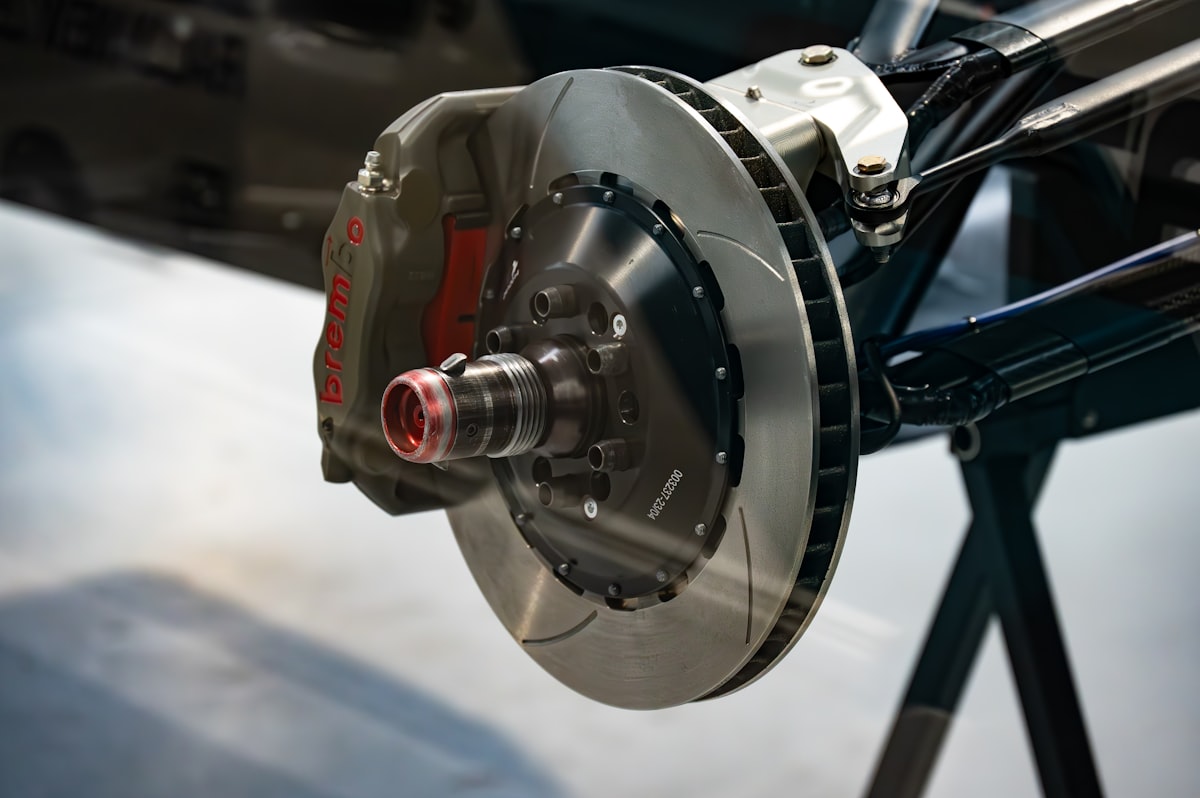
A grinding sound when you press the brake pedal is your car telling you something specific, and it is worth listening to. Most of the time it means the soft part of your brake pads has worn away and metal is now dragging on metal every time you slow down. It rarely fixes itself, it gets more expensive the longer it goes, and on a bad day it is the difference between a routine pad replacement and a tow. Here is how to read the noise, what it is costing you to ignore it, and what an honest brake repair actually involves.
Your brake pads have a thick layer of friction material bonded to a steel backing plate. Every stop wears a little of that material away. When enough of it is gone, the steel backing plate — or a wear indicator built into the pad — starts contacting the brake rotor directly. That contact is the grinding you hear, and often feel, through the pedal.
Once you are at metal-on-metal, two things happen at once. Your stopping distance gets longer, because bare steel does not grip like friction material. And the pad's backing plate starts carving grooves into the rotor, which is a far more expensive part to replace than a pad. That is the whole reason grinding is urgent and squealing is only a warning: squealing is the car asking you to book; grinding is the car telling you the cheap window has closed.
Not every brake noise means the same thing. The sound, and when it happens, narrows it down.
Most cars have a small metal tab on the pad called a wear indicator. When the pad wears down to a few millimetres, that tab touches the rotor and makes a squeal that is designed to be annoying. This is the good-news noise: it means you have caught the pads before the grinding stage. Book a brake check soon and you are likely looking at pads only.
This is metal-on-metal, as above — worn-through pads, and probably rotor damage starting. Do not put this one off. Every drive is cutting the rotor deeper.
A pulsing you feel in the pedal or the steering wheel, usually with a light grinding, often points to warped or unevenly worn rotors rather than pads alone. It is common after a lot of hard stops or a long downhill. If the shake is there at speed even when you are not braking, that is a different problem — a wheel-balance or alignment issue — and worth ruling out.
A grind that shows up when you turn but not when you brake is often not the brakes at all — it can be a failing wheel bearing or a CV joint. It still needs looking at, just by a different part of the car, which is where a proper diagnostic earns its keep.
Brakes are one of the few repairs where waiting reliably makes the bill bigger, and the maths is easy to follow.
So the same fault that is a modest pad job today becomes pads-plus-rotors next month and pads-plus-rotors-plus-caliper the month after. Nothing about the car changed except how long it was ignored.
You do not need tools to get a sense of how urgent this is.
One line worth being blunt about: if the grinding is loud, the pedal feels wrong, or the car pulls hard when you brake, stop driving it and call us. Brakes are the one system where "it can wait until the weekend" is the wrong instinct.
An honest brake job is not just slapping new pads on. When your car is on the lift we pull each wheel, measure the pads and the rotor thickness, check the rotors for grooves and warping, inspect the calipers and slide pins for sticking, and look at the brake hoses and fluid. Then we tell you what actually needs doing and what can wait — not everything on the list is always due at once, and a shop that quotes all four corners plus calipers on every car is one to be careful with.
Where it makes sense we replace pads and rotors in axle pairs — both fronts or both rears together — because matched brakes stop straight. We are not going to talk you into rear brakes that still have half their life left just because the fronts are done. You will see the worn parts; our technician Tony will show you what came off the car.
Every car is different, so treat these as bands rather than a quote. Front pads on a common car sit at the low end. Pads and rotors together on one axle land in the middle. A job that also needs a caliper, or a European car with pricier parts, sits at the top. The honest point is the one above: the band you land in is mostly decided by how long the noise was left, not by us. Come in while it is squealing and you stay at the bottom of the range.
If a needed brake repair is more than you planned for this month, we offer financing on repairs, so a safety job does not have to wait for payday.
Briefly and gently, to get the car to a shop — yes. As a way of life, no. Grinding means reduced stopping power and worsening damage, and it can progress to a brake that does not hold. If the grinding is loud or the pedal feels wrong, do not drive it; call for a tow.
Most last somewhere between 30,000 and 70,000 miles, but it depends heavily on how you drive. City stop-and-go, towing, hills, and hard stops wear pads faster than steady highway miles. That is why a mileage number is only a rough guide, and a look at the actual pad is the real answer.
Only if the rotors need it. If you caught the wear early and the rotors are still smooth and within thickness spec, pads alone are fine. Once grinding has grooved them, replacing or machining the rotors is usually part of doing the job properly — new pads on a chewed-up rotor will not stop well or last.
A light surface grind on the first stop or two, especially after the car has sat overnight in damp Graham weather, is often just a thin film of rust flashing off the rotors. If it clears after a couple of gentle stops and does not come back, it is usually nothing. A grind that stays is the kind described above.
It depends on the car and which parts are worn, which is exactly what the inspection tells us. We go over the price with you before we start anything, so the number is not a surprise on the bill. Call us at (253) 375-7057 for a straight answer for your vehicle.
If your brakes are grinding, the cheapest day to deal with it is today. We are on Meridian E in Graham, open Monday to Friday, and we will show you the actual pads and rotors so you can see what we see. Here is what our brake service covers — or just call (253) 375-7057 or book a time online.
Bring it in and we will tell you what it actually needs. Open Monday to Friday, 9am to 5pm.
Do you actually need winter tires in western Washington, or are your all-seasons enough? We don't get buried in snow, but we get…
The oil level keeps dropping but there's no puddle — so where is it going? A car that uses oil without leaking it is burning it…
Tire rotation is one of the cheapest, most-skipped pieces of maintenance there is — and skipping it wears out a set of tires…
Tell us the noise, the light, or the mileage. We will tell you what it takes.